
I recently read a book called ‘Raising Hare’ by Chloe Dalton. This book was one woman’s account of her experience of raising a leveret that she found near her home. Her journey through this process was extraordinary as she aimed not to domesticate the leveret, but to raise it to reintegrate it into the wild once it was old enough to do so.
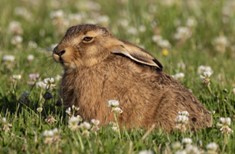
Through this process she was able to observe things about this animal, previously unseen or witnessed by humans and debunk some of the misinformation about this amazing animal. Previous information about hares and their habits was severely lacking and most was inaccurate. Over a number of years, she witnessed the secret life of hares and their behaviour.
One thing she noticed was the way that hares, like many of us, are creatures of habit. Following patterns of when they eat, sleep and forage for food. The hare would leave the house at set times during the day and return like clockwork. I’m sure many of us have noticed birds visiting our gardens at certain times each day and how badgers will do the same and follow certain specific tracks on their nocturnal nightly wanderings.
This got me thinking about how we, as humans, also have routines. We leave the house in the morning for work at the same time each day, we eat and drink at regular moments throughout the day and generally go to bed around the same time.
With the changing of the clocks in autumn, I wondered about how many species of wildlife had continued to follow their routines of leaving their burrows, sets and lairs, to go about their daily routines and how, when something changes in their world, there is an impact.
Wildlife vulnerability
Roadkill can directly and indirectly contribute to mortality rates outnumbering reproduction rates and, therefore, making populations vulnerable. One million animals are killed each year in the UK due to roadkill. The top 5 species affected and recorded in a study by Goodwin (2024) shows general roadkill rates as the following, between 2013 – 2024.
- Badger – 16,529
- Pheasant – 11,715
- Fox – 10,837
- Hedgehog – 8,554
- Rabbit – 7,201
There is also an increase in deer strikes by 14 times in the weeks following the clocks changing noted in a study by Cunningham et al (2022).
Our wildlife is vulnerable to human activity causing habitat loss and to the consequences of climate change. Our actions continue to challenge our wildlife and how they move amongst us. One study by Raymond et al (2021) showed by that in 1951 there were 4.2 million vehicles on the UK’s roads. By the end of 2016 this had increased to 37.3 million. Coupled with this, the overall length of the road network increased from 184,000 to 246,500 miles over the same period. Not only does the road network expansion take land from the wildlife, but it cuts across territorial areas isolating creatures off from mating partners and essential food sources.
Human vulnerability
The damage we are doing to the planet not only impacts ourselves but the delicate ecosystems that are essential to our survival. Biodiversity – the variability among living organisms from all sources – underpins all life on Earth. Biodiversity loss is occurring at an alarming rate, with recent estimates showing that species extinctions are currently 10 to 100 times higher than the natural baseline. This is largely due to human activities like deforestation, habitat fragmentation, and climate change, and yet we continue to act as if these delicate systems are secondary to our advancement.
We rely, for our own existence, on the balance of nature being maintained to ensure everything works in harmony. When we mess with the system it throws out the order of things, disrupting delicate ecological networks, ultimately leading to a reduction in wildlife damaging the balance of nature. We are all part of nature and to ignore this, is to do so at our peril.
Nancy Lund
References
Cunningham, C., Nunez, T., Hentati, Y., Sullender, B., Breen, C., Ganz, T., Kreling, S., Shively, K., Reese, E., Miles, J Prugh, L. (2022). Permanent daylight saving time would reduce deer-vehicle collisions. Current Biology. Available at: https://www.sciencedirect.com/science/article/pii/S0960982222016153
Goodwin, N. (2024). Badgers are vulnerable on the roads right now – here’s how to protect them. Available at: https://www.selectcarleasing.co.uk/news/article/badgers-roadkill-report-2024
Raymond, S., Schwartz, W., Thomas, J., Chadwick, E., Perkins, E. (2021). Temporal patterns of wildlife roadkill in the UK. PLOSONE. Available at: https://journals.plos.org/plosone/article?id=10.1371/journal.pone.0258083
Roberts, G. (2024) Warning after collision data shows crash increase after clock change. Fellet News. Available at: https://www.fleetnews.co.uk/news/warning-after-collision-data-shows-crash-increase-after-clock-change
Rogers, D. (2023). Impact of roadkill worse than thought, study reveals – and some mammal populations could even reach ‘tipping point’. Nottingham Trent University. Available at: https://www.ntu.ac.uk/about-us/news/news-articles/2023/03/impact-of-roadkill-worse-than-thought,-study-reveals-and-some-mammal-populations-could-even-reach-tipping-point
World Health Organisation (WHO) 2025, Biodiversity. Available at: https://www.who.int/news-room/fact-sheets/detail/biodiversity